Blog

Simplicity wins every time

Simplicity wins every timeThe idea of keeping things simple in both life and work has popped up everywhere I’ve turned lately – from social media to business to family and friends. Okay, okay, I can take a hint. 🙌🏼 I get it: It’s worth talking about again.

“If you can’t explain it simply, you don’t understand it well enough.”

~Albert Einstein

Such wise words and so true. So why is it that we frequently struggle with keeping things simple? Perhaps because our natural inclination is to want people to believe in our businesses and beliefs as much as we do – and that often means we try to make things sound more sophisticated or more impressive than we need to.

“Simplicity is the ultimate sophistication.”

~Leonardo Da Vinci

So, how do we keep it simple?

One of the tricks I learned early on in my career was to tell stories as if you’re speaking to a friend. How would you explain your business – and why you do what you do – during a face-to-face conversation?

Would you use formal language and lots of jargon? You could, but then you’d probably be met with confused or blank looks, and you’d quickly adjust the way you’re explaining things, right?

It’s easier to see this when you’re speaking directly to someone, but if you visualize yourself speaking to someone when writing your promotions, your website content and your blog posts, you’ll connect with the person reading it.

Just let your passion shine through. Simplicity wins every time.

Want to learn more about how you can create your own ripple effect? Let’s start today.

Click FOLLOW in the sidebar to make sure you don’t miss out on future posts about creating your own ripple effect.


Personality matters!

casualIt’s funny to me how often this notion of personality, style and even how we dress arises in our daily business interactions. Just recently, I had a conversation with peers about dress code and first impressions.

Now, you may be thinking to yourself: How in the world does how I dress and my personality have anything do with how I market my business? That’s not part of marketing strategy…is it? 🤔

Yes. It is. After all, the saying goes…

You never have a second chance to make a first impression.

And, that goes for your business, too. For me, dressy jeans, a classy shirt, nice fitted jacket and heels are the impression I’d like to make. It’s friendly, stylish, casual, fun and, yes, professional. And that represents not only me, but Ripple Effect.

For many, that may seem odd; it goes against tradition. But, it would be odd to me to present myself – and my company – as something I’m not. And, I’m not the suit-wearing, conservative business woman who was once the expectation in the business world.

People are just people. Why should we put on airs? Why shouldn’t we look nice, look professional and…simply show off our personality. After all, personality matters – it speaks to who we are. And, more importantly, it speaks to who our company is.

How can you possibly connect to another person if they look and sound and act exactly like every other person? If every person in the room is dressed in a black suit, where’s the personality? Where’s the fun? Where’s the individuality? How do I know who you are – who your company is?

I crave those differences. I love quirkiness. I want to know what makes you you. What drives you? Why do you wear a compass necklace? Why do you have a tatoo of a dove on your ankle? Why do you choose to dye one strand of your hair pink? Or, even…why do you choose to wear a black suit?

And more importantly, how does that impact your business? How does your personality translate to your company’s voice?

Being true to yourself is important when interacting with prospective clients, crafting marketing messages and demonstrating who you are and what you bring to the table.

After all…personality matters. It’s a ripple effect that infuses life into your business.

Learn how you can create your own ripple effect. Let’s start today.

Click FOLLOW today to make sure you don’t miss out on future posts to learn how you can create your own ripple effect.
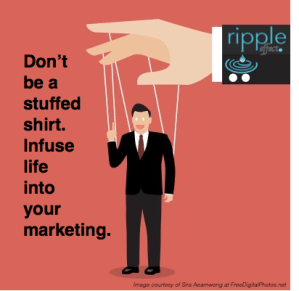
Don’t be a stuffed shirt. Infuse life into your marketing.

stuffed shirt puppetOne of the hardest things any of us have to do when marketing or communicating is make our meaning clear. For some reason businesses seem to think that using jargon makes them sound more impressive. Instead, it simply means no one can figure out what the heck they’re saying!

Ragan Communications posted an article a few years ago that perfectly illustrated this (ridiculous) phenomenon. It went something like this:

It’s mission-critical that we circle back on this important matter of corporate jargon in the workplace. Let’s focus on the low-hanging fruit with a small group first and then loop everyone in. Being proactive about our learnings will really incentivize the group to focus on the most critical action items and value-add for maximum impact. Let’s start high level, drill down from there, and circle back after lunch to figure out next steps.

Clear as mud, right? 😳 Ummm, no.

Don’t be a stuffed shirt.

Just because you’re in business, doesn’t mean you have to sound like it. Back to our discussion about telling stories, people connect to others because they’re drawn to their humor, their style, their quirkiness, etc.

So, who are you? Who is your business? Let that shine through in the way you talk about your company and in the way you speak to your customers and potential customers. People will appreciate it and be drawn to your authenticity.

5 ways to remove the jargon & sound like a human being.

1. Your company’s voice is already part of who you are and who your company is. It’s inherent in why you started your business in the first place. It’s just a matter of paying attention to how you conduct business everyday to unearth it.

2. Play up your personality. As the owner of your company, your personality is infused throughout the culture. It’s in everything you do. So, who are you? Proper? Quirky? Funny? Offbeat? Find ways to incorporate your personality into all of your communications. It makes them authentic.

3. Choose short over long. Often times people think using longer words is better. No. It’s just cumbersome for your readers. Use is better than utilize. Change is better than modify. Etc. Keep it as simple as possible to get your point across.

4. Keep your audience in mind. Who are you writing to? Are they engineers or sales people? Astrophysicists or teachers? Your audience plays a key part in how you communicate – in which words you choose. Always read whatever you write or push out as a promotion with the same lens your audience would.

5. Be you. Be authentic. Above all, you have to be you. You’ll notice that while I said you should choose short over long, I still used words like cumbersome and inherent. That’s because that’s how I speak. And if you ever met me, you’d hear me use similar words. You have to be authentic to who you are. Never change that.

Just those five simple things will infuse life and personality into your marketing efforts. Your clients and customers will appreciate the fact that you don’t sound like all of your competition – and instead, you sound like, well, a human being they’d like to get to know. And a company they’d like to do business with.

Want to learn more? Find out how you can create your own ripple effect. Let’s start today.

Click FOLLOW today to make sure you don’t miss out on future posts to learn how you can create your own ripple effect.
How to tell a story that compels instead of sells

How will you tell your story?

Have you ever thought about how often we tell stories throughout the day?

“You’ll never believe what happened to me this morning!”

“Hey, guess what?”

Whether at work or at home, stories connect us to others, make us human, show our personality. They enable us to share ideas and experiences with others.

But, I can’t tell stories for business, can I?

Why not? How is telling stories for business any different than sharing them with our friends and family? After all, we’re all drawn to interesting people, scenarios and stories. And we shouldn’t discount the power that has to make people want to partner with us.

Besides, simply selling our products and services isn’t enough to make people want to connect with us. And…if we ‘sell’ too much, it can even work against us. I mean…how do you like it when people constantly try to sell you? 😝

How to tell a story that compels instead of sells

The good thing is, there’s an excellent way to think about the stories you tell – whether verbally, in a blog post or a marketing slick – however you’re connecting with your customers. It’s the simple anatomy of a story, and it goes something like this:

1. Once upon a time…
(I finally did it! I started my own company.)

2. Suddenly…
(Now what? I have people asking me when I’m going to get a website, get on social and have some information about my business. But, I don’t know where to begin.)

3. Luckily…
(Thankfully, I talked to Ripple Effect, and they helped me map out my entire marketing strategy and develop a few easy templates I can use for my marketing efforts.)

4. Happily ever after…
(Now, I have a plan and the tools I can use to market my business.)

The same approach can be taken for your business. If people are looking to you for answers, it means they have a problem or challenge they need to solve. And they want your help. So…

…tell your story. Your way.

(Psst…If you’re still unsure how to start, Meet Bob. This follows the anatomy and – hopefully – piques the interest of those seeking marketing strategy and communications help for their business.)

Don’t forget the ‘happily ever after’

With all of that said, don’t forget how important it is to make sure your audience understands their next step. After all, all of us in business are there to provide a product or service. And if we don’t ask our audience to take action, we’re doing ourselves and our potential clients a disservice.

So, what’s next?

If you’re ready to learn more and want to create your own ripple effect, give us a call at 847.245.3236 or shoot us an email today.

And be sure to click FOLLOW in the sidebar today to make sure you don’t miss out on future posts about creating your own ripple effect.

The secret to better communication

SecretA few years ago, my son came home from school and demanded: Do you know what kind of learner I am, Mom?? 😳Ummm…no? Should I?

The answer? Yes! Because it explained, well…everything.

My son is an auditory learner. That means he needs to say and hear things spoken aloud to learn and retain them. The minute he said that, I was like: Of course! No wonder he’s always speaking to himself and wanting me to share things verbally vs. showing him a visual. And kudos to the teacher for realizing how important it is to know this about her students, and also for the students to know about themselves!

And it’s no different for us in business. This is the secret to better communication – understanding how our clients/customers learn so we can tailor our messages and conversations to that style.

Listen up!

You see, the way we learn doesn’t change simply because we become adults or enter the workforce. It’s inherent in who we are. That’s why understanding how people learn is so important as it pertains to marketing efforts.

There are three types of learners:

  1. Visual
  2. Auditory
  3. Kinesthetic (tactile)

And, they’re all quite different. Typically, we can pinpoint our primary learning style, but often fall into two or even all three categories – just to varying degrees.

We all learn differently.

But, the key point is: We all learn differently. And when we’re interacting with our employees, family, clients, customers, business partners, this is potentially the most important aspect of marketing to keep in mind. After all, it doesn’t matter how amazing our story, our business or our philosophy, if the person we’re sharing it with isn’t able to process, understand or retain it, it’s worthless.

It has nothing to do with your generation.

The other thing to keep in mind – and this is always a big a-ha – is that our learning style has nothing to do with our generation. Generational preferences are definitely something to keep in mind regarding marketing, but that’s typically more about type of media (face-to-face, print, email, text, social) and the type of content within it (historical info, experience, teaching/sharing expertise, peer reviews) – not about how we learn.

So, what is your learning style?

It’s often helpful to understand how we learn before applying that knowledge to the other learning styles attributes. There are several assessments to determine this, but here’s a good one: VAK assessment.

The nitty gritty

Visual learners

  • Use visual objects such as graphs, charts, pictures, and want to see information.
  • Can read body language well and have a good perception of aesthetics.
  • Able to memorize and recall various information.
  • Tend to remember things that are written down.
  • Learn better by watching.

Auditory learners

  • Retain information through hearing and speaking.
  • Often prefer to be told how to do things.
  • Summarize the main points out loud to help with memorization.
  • Notice different aspects of speaking.
  • Often have talents in music and may concentrate better with soft music playing in the background.
  • Enjoy conversations and podcasts.

Kinesthetic/tactile learners

  • Like to use the hands-on approach to learn new material.
  • Are generally good in math and science.
  • Would rather demonstrate how to do something rather than verbally explain it.
  • Usually prefer group work more than others.
  • Need to physically manipulate something – or be doing something physical while learning (standing, walking, chewing gum).

THINK ABOUT: What are the learning style cues you can pick up on when meeting with your clients/customers to help you understand how best to market and communicate with them?

Each of us learns differently, and to ensure maximum understanding and retention, it’s important to provide our audience with visual, auditory and tactile avenues to ensure one of them resonates with their own learning style.

Ready to learn more? Want to create your own ripple effect? Let’s start today.

Click FOLLOW today to make sure you don’t miss out on future posts to learn how you can create your own ripple effect.

Don’t change. Be who you are.

Source: gathutopper.wordpress.com

I was reminded today that it’s important to be who you are and not change for anyone. After all, when we do that, we give up a little bit of ourselves. And that’s not fair to us – or anyone else.

I had been in the process of writing a blog post about a topic I ‘thought’ was something I ‘should’ write – instead of embracing who I am, how I sound and what I believe. It was only when I offered advice to someone else saying, “No, no. Don’t change who you are to please someone else. Be you. You’re awesome. And people will dig it,” that it dawned on me: I was doing the same thing. Ugh. ◔̯◔ So, I stopped writing the post, re-centered and decided to embrace me.

Who are you?

Businesses are no different. You have to figure out who you are, how you want to sound – formal, casual, somewhere in between – and what makes you different from everyone else. After all, that’s the way we connect. That’s how relationships are built, whether business or personal.

Above all else, we have to be us. Period.

So…who are you? Who do you want to be? How do you want to get there? Are you ready to create your own ripple effect? Contact us today.

Click FOLLOW today to make sure you don’t miss out on future posts to learn how you can create your own ripple effect.

The forest for the trees

See the forest for the trees
Source: Rachel Olshausen

Why is it that it’s so easy to fall into the trap of focusing on only one tree when there’s an entire forest around us? It happens all the time. We get caught up in one thing we’re trying to accomplish and forget to broaden our view a bit to take in the big picture. And when we do, we miss the forest for the trees.

So, how can we stop doing that? 🙂

How to see the forest

  1. Before you start any endeavor – whether a simple meeting, a new project or a new marketing piece – ask yourself: What is my objective? What am I trying to accomplish with this meeting? project? communication piece? This will help you realize that while you may want to check off a single task, each action item has a ripple effect.

2. Then ask: What do I want the meeting participants/project participants/audience to do? What action do I want them to take? In other words, what is your overall objective?

Simply keeping those two things in mind can make the difference between seeing a single lovely tree – or a realizing there’s a huge, beautiful forest all around us.

Ready to learn how to create your own ripple effect? Contact us today.

Click FOLLOW today to make sure you don’t miss out on future posts to learn how you can create your own ripple effect.

Begin at the beginning…

Begin at the beginning

Have you ever wondered how to create your own marketing strategy?

I recently had the opportunity to speak to a group of business owners about that very thing. And, to understand how to get where we want to go, we have to begin at the beginning.

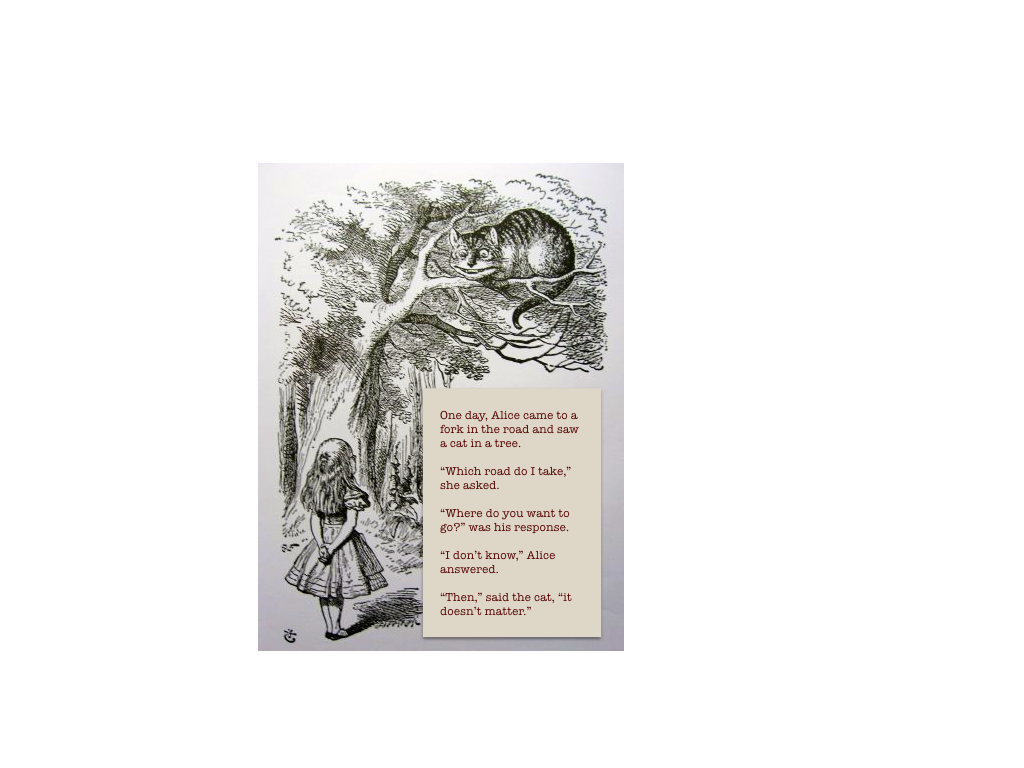
After all, as the Cheshire Cat says:

If you don’t know where you want to go, then it doesn’t really matter.

So, let’s begin:

1. What is your objective?

If you don’t know what it is you’re trying to accomplish…how can you know when you’ve accomplished it? And, more importantly, how can you put a strategy in place to achieve those objectives? This is one of the primary things we often forget when we begin our journey – typically because we’re so excited to dive in and get going. 🙂 But…it pays to take a step back, assess what you want to accomplish and define what it is you want to achieve for your business.

2. Who is your audience?

Is there a certain group of people you’re targeting? Multiple groups? Who are your customers or clients? Do you have multiple types of customers? Do they have different needs or objectives? It’s important to identify who you’re targeting with your marketing so you can tailor the messages to resonate with each audience.

3. What makes you different?

And finally, what makes you different than your competitors? Your customers have a lot of choices today, and they need a reason to choose you. What is it that makes you stand out from your competitors? Once you determine that, you can narrow your messages to play up that differentiator and attract customers who value that aspect of your business.

Ready to learn more – and find out how to create your ripple effect? Let’s get started today.

Click FOLLOW today to make sure you don’t miss out on future posts about creating your own ripple effect.